Throughout history, astronomy has advanced hand in hand with technology. From ancient monuments like Stonehenge and the Mayan pyramids, used to track celestial movements, to the great domed observatories of the Renaissance, every generation has built new tools to push the boundaries of what we can see. Today, we stand at the edge of another revolution in astronomy—one defined by futuristic observatories that will completely transform our understanding of the universe.
These projects are larger, more sophisticated, and more ambitious than anything humanity has attempted before. They are being built in some of the most remote locations on Earth, such as the deserts of Chile and the high mountains of Hawaii, and across international borders, with collaborations involving dozens of countries. Their instruments are designed to detect faint signals of distant galaxies, reveal the atmospheres of exoplanets, and even map the invisible structure of dark matter.
But these observatories are not only scientific marvels—they are also symbols of global cooperation. Each requires massive investments, advanced engineering, and the combined expertise of astronomers, physicists, and engineers worldwide. The discoveries they make will not only answer long-standing questions about the cosmos but may also raise entirely new ones.
In this article, we’ll explore the most important futuristic observatories currently under construction or in development. From the Extremely Large Telescope (ELT) in Chile to the Square Kilometre Array (SKA) in Africa and Australia, these projects promise to change the way we look at the universe and, perhaps, how we understand our own place within it.
Extremely Large Telescope (ELT) – Chile
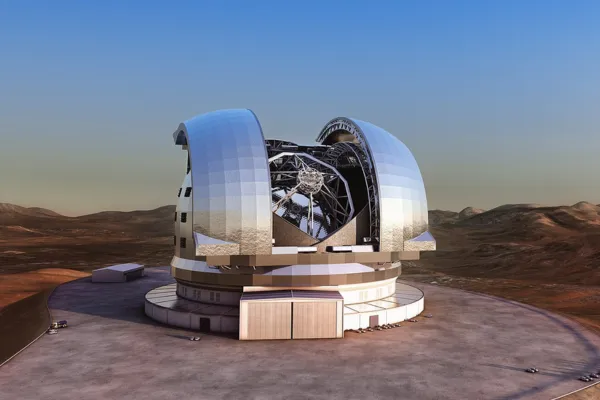
The Extremely Large Telescope (ELT), currently under construction in Chile’s Atacama Desert, is set to become the largest optical and infrared telescope in the world. Built by the European Southern Observatory (ESO), the ELT will feature a staggering 39-meter segmented primary mirror, dwarfing all existing ground-based telescopes. This immense size will allow it to collect more light than any telescope ever built, giving astronomers an unprecedented window into the cosmos.
Once completed, the ELT will be capable of answering some of astronomy’s most pressing questions. It will search for and study Earth-like exoplanets, analyzing their atmospheres for signs of life. It will peer back in time to observe the first galaxies that formed after the Big Bang and help unravel the mysteries of dark matter and dark energy, the invisible forces shaping our universe.
Chile’s Atacama Desert provides the perfect setting for this mega-project. Its dry air, high altitude, and clear skies more than 300 nights a year make it one of the best observing sites on Earth. The ELT is expected to produce images that are up to 16 times sharper than those from the Hubble Space Telescope.
For space enthusiasts and scientists alike, the ELT represents a bold leap forward. It is not just a telescope—it is a machine designed to change the way we see the universe, bringing us closer than ever before to answering the ultimate question: Are we alone?
Giant Magellan Telescope (GMT) – Chile
Also rising from the Atacama Desert in Chile is the Giant Magellan Telescope (GMT), another groundbreaking project that will redefine ground-based astronomy. Scheduled for completion later this decade, the GMT will feature seven enormous mirrors, each 8.4 meters in diameter. Combined, they will create the equivalent of a single 25-meter primary mirror, giving the telescope more than six times the resolving power of the Hubble Space Telescope.
The GMT’s design emphasizes both sharpness and flexibility. It will use advanced adaptive optics, which correct distortions caused by Earth’s atmosphere in real time, producing images with incredible clarity. This will allow astronomers to directly observe distant exoplanets, study their atmospheres, and search for potential biosignatures.
Beyond exoplanet science, the GMT will probe fundamental cosmic mysteries: the nature of dark matter, the formation of the first stars and galaxies, and the expansion of the universe. Its wide range of instruments will make it one of the most versatile telescopes ever built.
Like the ELT, the GMT benefits from the Atacama’s extraordinary skies. With minimal light pollution and dry conditions, the desert is the closest Earthly equivalent to observing from space. Once operational, the GMT will not only expand our scientific horizons but also serve as a powerful symbol of international collaboration, involving institutions from the United States, Australia, Brazil, and South Korea.
Thirty Meter Telescope (TMT) – Hawaii/Alternative Site
The Thirty Meter Telescope (TMT) is another ambitious project designed to push the boundaries of optical astronomy. Planned as a 30-meter segmented mirror telescope, it will rank among the largest telescopes on Earth once completed. Its advanced adaptive optics system will provide images that are more than 10 times sharper than those from the Hubble Space Telescope.
The TMT aims to tackle some of astronomy’s biggest challenges: mapping the distribution of dark matter, investigating how galaxies form, and studying the atmospheres of exoplanets in unprecedented detail. Its instruments will be capable of detecting faint signals from the earliest stars and galaxies, giving us a clearer view of the young universe.
Originally planned for Mauna Kea in Hawaii, the project has faced controversy due to cultural and environmental concerns. Mauna Kea is a sacred site for Native Hawaiians, leading to protests and delays. As a result, an alternative site in the Canary Islands (Spain) has also been considered.
Despite these challenges, the TMT remains a highly anticipated project. Wherever it is built, it will represent a monumental step forward in ground-based astronomy, offering insights that could reshape our understanding of the cosmos.
Square Kilometre Array (SKA) – South Africa & Australia
While most futuristic observatories focus on optical and infrared astronomy, the Square Kilometre Array (SKA) is set to revolutionize radio astronomy. Spread across two continents—South Africa and Australia—the SKA will be the largest and most sensitive radio telescope ever constructed. Its name comes from its planned collecting area of one square kilometer, though in reality it will be composed of thousands of antennas spread across vast distances.
The SKA’s mission is ambitious: it will explore cosmic magnetism, test Einstein’s theories of gravity, and investigate the role of dark energy in the expansion of the universe. One of its most exciting goals is the search for signals that might indicate the existence of extraterrestrial intelligence (SETI).
By capturing radio waves from deep space, the SKA will allow scientists to peer into regions of the universe invisible to optical telescopes, such as the formation of the first stars and galaxies hidden behind clouds of dust. Its unprecedented sensitivity will produce enormous amounts of data—so much, in fact, that it will require cutting-edge computing systems to process it.
The SKA is also a model of international collaboration, involving over a dozen countries. When completed, it will transform radio astronomy in the same way the Hubble Space Telescope transformed optical astronomy. For scientists and the public alike, the SKA promises to answer some of the most profound questions about our universe.
Vera C. Rubin Observatory – Chile
Formerly known as the Large Synoptic Survey Telescope (LSST), the Vera C. Rubin Observatory is one of the most exciting astronomical projects of the 21st century. Located in northern Chile, it is designed to take an unprecedented wide-field survey of the entire visible sky every few nights. Instead of focusing on individual objects, the Rubin Observatory will map billions of stars, galaxies, and cosmic events, creating a dynamic picture of the universe in motion.
At the heart of this project is the 8.4-meter Simonyi Survey Telescope equipped with the world’s largest digital camera for astronomy—containing 3.2 gigapixels. This incredible instrument will capture vast images of the sky, each so detailed that it would take hundreds of ultra-high-definition televisions to display one at full resolution.
The observatory’s primary mission is to conduct the Legacy Survey of Space and Time (LSST), which will generate a comprehensive dataset over ten years. This survey will help scientists study the mysterious forces of dark energy and dark matter, trace the formation of galaxies, and detect potentially hazardous asteroids near Earth.
What makes the Rubin Observatory revolutionary is its focus on change. By repeatedly imaging the entire sky, it will catch transient events like supernovae, collisions of neutron stars, and variable stars in real time. For astronomers, it’s like having a constantly updated video of the cosmos. For the public, it promises to provide one of the most detailed maps of the universe ever made.
Space-Based Observatories of the Future
While ground-based telescopes are becoming larger and more powerful, the future of astronomy also lies in space-based observatories. Free from the distortions of Earth’s atmosphere, these instruments can see deeper into the cosmos with unmatched clarity. Following the legacy of the Hubble Space Telescope and the groundbreaking James Webb Space Telescope (JWST), several ambitious missions are already being designed.
Among the most promising is LUVOIR (Large UV/Optical/IR Surveyor), a proposed space telescope that could dwarf even the JWST in size and capability. With a massive segmented mirror, LUVOIR would study exoplanet atmospheres in detail, potentially detecting chemical signatures of life. Another concept, HabEx (Habitable Exoplanet Observatory), focuses specifically on imaging Earth-like worlds and searching for biosignatures in their atmospheres.
Meanwhile, Origins Space Telescope is designed to study the cold universe, probing star formation and planetary systems hidden in clouds of dust. These missions, still in the planning or concept stages, reflect the next leap forward in humanity’s quest to understand the cosmos.
Space-based observatories are extremely expensive and technologically challenging, requiring decades of planning and international cooperation. But the potential payoff is enormous. They could answer the most profound questions in science: How do galaxies form? What is the nature of dark energy? And, most compelling of all—are we alone in the universe?
Practical Implications of Futuristic Observatories
The futuristic observatories currently under construction will not only transform astronomy but also impact technology, education, and even society as a whole. At the scientific level, these instruments are designed to tackle some of the most pressing questions in cosmology: the nature of dark matter and dark energy, the formation of the earliest galaxies, and the search for habitable exoplanets. The data they provide will shape our understanding of the universe for decades to come.
Beyond pure science, these projects drive innovation in engineering, optics, and computing. For example, the Square Kilometre Array (SKA) will generate more data than the entire internet produces in a day, requiring new advances in artificial intelligence and data processing. Similarly, adaptive optics systems developed for telescopes like the Giant Magellan Telescope (GMT) and Thirty Meter Telescope (TMT) could inspire applications in medical imaging and satellite technology.
The public will also benefit through outreach and citizen science. Observatories such as the Vera C. Rubin Observatory will release enormous datasets that amateur astronomers and enthusiasts can help analyze, democratizing the process of discovery. This means the next big astronomical find might not come from a professional astronomer, but from a curious individual anywhere in the world.
Finally, these observatories highlight the power of global collaboration. They involve partnerships across continents and cultures, reminding us that the quest to understand the cosmos is a shared human endeavor. The implications go far beyond science—they reinforce unity and the universal drive to explore.
Conclusion
As we look to the future, it is clear that astronomy is entering a new golden age. The construction of observatories like the Extremely Large Telescope, the Square Kilometre Array, and the Vera C. Rubin Observatory signals a shift toward unprecedented levels of detail, scope, and ambition in exploring the universe. These projects are not just scientific tools; they are monuments to human curiosity, creativity, and cooperation.
What makes them truly exciting is their potential to answer questions that have fascinated humanity for millennia. Are we alone in the cosmos? How did the first galaxies form? What forces shape the expansion of the universe? With futuristic observatories, we are closer than ever to finding answers.
For travelers and astronomy enthusiasts, following these projects is also a source of inspiration. Many of these facilities will eventually welcome visitors, offering the chance to see firsthand the instruments that push the boundaries of knowledge. Others, like the Rubin Observatory, will share data openly with the world, ensuring that discovery is a collective experience.
Ultimately, these observatories remind us that while Earth is small in the vastness of space, our curiosity is limitless. By investing in the future of astronomy, we are not only expanding our understanding of the universe but also strengthening our connection to it. The next era of discovery is already on the horizon—and it promises to change everything we know about the cosmos.