
Since the dawn of civilization, humanity has turned to the night sky for guidance, inspiration, and meaning. The stars were more than distant points of light—they were tools for survival, symbols of power, and windows into the divine. For ancient peoples, the heavens offered a way to measure time, plan harvests, navigate landscapes, and interpret the will of the gods. Without modern technology, the regularity of celestial movements was the most reliable guide available, transforming the stars into the first universal clock and compass.
The great civilizations of antiquity—Mesopotamia, Egypt, Greece, Rome, China, and the Maya—each developed their own ways of reading the stars. Some used them as calendars to organize agricultural cycles, while others aligned temples and monuments with celestial bodies to reflect spiritual beliefs. Myths and legends were inscribed into the constellations, turning the sky into a cultural archive that preserved values and stories across generations.
At the same time, the study of stars became a form of power. Kings, priests, and rulers often relied on star knowledge to legitimize authority or predict political events. By controlling access to this knowledge, elites reinforced their position as intermediaries between heaven and earth.
In this article, we will explore how the stars shaped the rise of great civilizations, blending science, religion, and myth. By examining the skies of Mesopotamia, Egypt, Greece, Rome, the pre-Columbian Americas, and China, we uncover a shared truth: the stars were indispensable in building the foundations of human culture.
Mesopotamia: The Birthplace of Celestial Knowledge
Mesopotamia, often called the “cradle of civilization,” was also the birthplace of systematic sky-watching. As early as 2000 BCE, Babylonian priests meticulously observed the heavens, recording the movements of stars and planets on clay tablets. These observations gave rise to some of the first star catalogs and, eventually, the zodiac system that still influences astrology today.
For the Mesopotamians, the stars were not only natural phenomena but also divine messages. They believed that the gods communicated their will through celestial signs. Eclipses, planetary alignments, or unusual star patterns were interpreted as omens that could foretell famine, prosperity, or the fate of kings. This close link between astronomy and religion meant that priests held immense power, serving as both scientists and interpreters of the divine.
Beyond spiritual interpretation, Mesopotamian astronomy had practical uses. By tracking constellations, they created calendars that organized agricultural cycles, ensuring that crops were planted and harvested at the right time. Navigation along rivers like the Tigris and Euphrates also benefited from star knowledge.
The influence of Mesopotamian stargazing spread widely. Their zodiac and planetary interpretations reached Greece, Rome, and beyond, shaping Western astrology and laying the groundwork for later astronomy. In Mesopotamia, the stars were more than distant lights—they were the foundation of both cosmic order and earthly governance.
Ancient Egypt: Stars as Symbols of Life and Death
In ancient Egypt, the stars were deeply connected to both earthly survival and spiritual beliefs. Perhaps the most important celestial event was the heliacal rising of Sirius, known as Sopdet in Egyptian culture. Its annual appearance in the pre-dawn sky coincided with the flooding of the Nile, the lifeblood of Egypt. This event brought fertile soil to the riverbanks and determined the success of harvests. Thus, Sirius became a symbol of renewal, abundance, and divine order.
The Egyptians also believed that stars represented gods, spirits, and even the souls of the dead. Orion, for example, was associated with Osiris, the god of the afterlife and resurrection. The Milky Way was sometimes interpreted as a celestial river, mirroring the Nile and linking earthly life with the heavens. These cosmic associations shaped rituals, myths, and even architecture.
The alignment of monuments with the stars highlights Egypt’s advanced integration of astronomy and religion. The pyramids at Giza are thought to align with Orion’s Belt, symbolizing the pharaoh’s journey to join the gods in the afterlife. Temples were also oriented toward solstices and star risings, ensuring that worship followed cosmic rhythms.
For the Egyptians, the stars were not distant or abstract—they were the guardians of life, agriculture, and eternity. They ensured that society remained in harmony with the cosmos, making the heavens a sacred mirror of both nature and the divine.
Greece and Rome: Myth, Philosophy, and Science
In Greece, the stars became the foundation for both mythology and early scientific thought. Constellations were mapped onto stories of gods and heroes, transforming the night sky into a theater of myths. Orion, Perseus, and Andromeda are still remembered today, reflecting timeless tales of bravery, love, and tragedy. These myths gave meaning to celestial patterns and ensured that cultural stories were passed from one generation to the next.
Greek philosophers, however, also sought rational explanations for the cosmos. Thinkers like Pythagoras, Aristotle, and later Hipparchus approached the stars with mathematical and observational methods. Hipparchus is credited with creating one of the first star catalogs and even discovering the precession of the equinoxes. This blend of myth and science shows how Greek culture balanced imagination with inquiry.
Rome inherited much of Greek astronomy and astrology, adapting the myths and scientific works for its own use. The writings of Ptolemy in the Almagest became foundational texts for centuries, blending mathematical astronomy with astrological interpretations. Roman leaders also consulted astrologers, believing that the stars could influence politics and warfare.
Together, Greece and Rome left a legacy that shaped the Western understanding of the heavens. Their constellations and myths remain central in astronomy, while their scientific approaches paved the way for modern exploration of the universe. For these cultures, the stars were both storytellers and scientific puzzles, bridging the gap between myth and measurement.
The Mayas and Other Pre-Columbian Cultures
In the Americas, the Maya developed one of the most sophisticated systems of astronomy in the ancient world. They carefully tracked the movements of the Sun, Moon, Venus, and stars, integrating celestial knowledge into their religion, politics, and daily life. Their calendar system, which included the Haab’ (solar year) and the Tzolk’in (ritual calendar), was deeply connected to astronomical observations. These calendars determined the timing of festivals, agricultural cycles, and even political decisions.
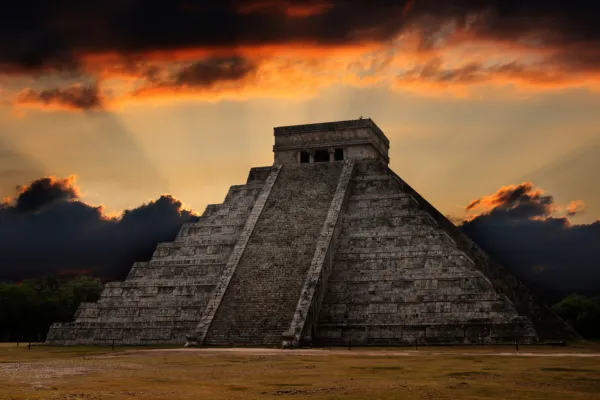
The stars were also woven into their mythology. Temples and pyramids, such as those at Chichén Itzá, were aligned with celestial events like solstices and equinoxes. On certain days, shadows formed by the steps of the Pyramid of Kukulcán created the illusion of a serpent slithering down the structure—an extraordinary fusion of architecture, religion, and astronomy.
Beyond the Maya, other Pre-Columbian cultures also saw the stars as essential. The Aztecs used celestial cycles to guide rituals and human sacrifices, believing that maintaining cosmic balance depended on human offerings. The Inca identified “dark constellations” within the Milky Way, such as the llama and serpent, which signaled seasonal changes critical for agriculture.
For these civilizations, the stars were not distant objects but living forces intertwined with the fate of humanity. They provided order, meaning, and divine legitimacy to rulers, ensuring that society was aligned with the cosmos.
China: Stars as a Reflection of Imperial Order
In ancient China, the stars were seen as a direct reflection of earthly order. The heavens were divided into regions known as the “Three Enclosures” and the “Twenty-Eight Mansions,” a complex celestial system that paralleled the structure of imperial bureaucracy. Each star or constellation represented an aspect of the empire—emperors, officials, soldiers, and even family roles. This mirrored organization reinforced the belief that harmony between heaven and earth was essential for prosperity.
Astronomy in China was both a science and a tool of governance. Court astronomers carefully recorded eclipses, comets, and planetary movements, interpreting them as signs of approval or warnings from heaven. A solar or lunar eclipse could be seen as a challenge to an emperor’s legitimacy, making astronomy a matter of political stability.
Stars also played a practical role in agriculture and navigation. Farmers relied on star risings to mark planting seasons, while travelers used celestial patterns to guide their journeys across vast landscapes.
Chinese astronomy was remarkably advanced. Records dating back thousands of years include detailed star maps and observations of phenomena like supernovae. This knowledge spread across Asia, influencing neighboring cultures and contributing to global astronomical heritage.
For the Chinese, the stars were not only a scientific puzzle but also a cosmic mandate. They confirmed the emperor’s authority, guided the people’s work, and symbolized the balance between human society and the universe.
Shared Functions of Stars Across Civilizations
Although ancient civilizations developed unique interpretations of the night sky, many of their uses of the stars reveal striking similarities. One of the most common roles was as a calendar. From Mesopotamia to the Maya, the stars marked agricultural cycles, guiding when to plant, harvest, and prepare for seasonal changes. Sirius rising over Egypt signaled the flooding of the Nile, while the Inca used the Milky Way’s “dark constellations” to anticipate the rainy season.
Navigation was another shared function. Seafaring peoples and desert travelers relied on fixed stars to guide them across oceans and arid landscapes. The North Star, for example, was essential for orientation in both Eastern and Western traditions.
Beyond practical survival, stars also carried deep symbolic and religious meaning. They were seen as messengers of the gods, souls of ancestors, or representations of divine order. Civilizations as distant as the Zulu of Africa and the Greeks of Europe both believed the heavens reflected human destiny and cosmic harmony.
Importantly, the stars also served as tools of power. Priests, kings, and emperors used celestial knowledge to legitimize authority, claiming alignment between their rule and the order of the cosmos. By controlling access to astronomical wisdom, elites reinforced their status as mediators between heaven and earth.
These shared functions highlight that, while myths and symbols varied, the role of the stars in shaping culture, survival, and power was nearly universal.
Conclusion
The stars were not just decorations in the ancient sky; they were central to the rise and organization of great civilizations. In Mesopotamia, they became the language of the gods and the foundation of astrology. In Egypt, they marked the rhythms of the Nile and symbolized eternal life. In Greece and Rome, they inspired both mythology and early science, while in China, they mirrored imperial order and legitimacy. Across the Americas, they guided the Maya, Aztecs, and Inca in creating calendars, aligning temples, and structuring their societies.
What unites these diverse cultures is the understanding that the heavens and human life are inseparable. The stars guided survival, legitimized power, and inspired stories that carried cultural values across generations. They were simultaneously scientific instruments, religious symbols, and political tools.
Today, modern astronomy has separated itself from myth and symbolism, offering a purely scientific view of the universe. Yet the legacy of ancient civilizations reminds us that our relationship with the stars is not only about knowledge but also about meaning. The night sky has always been a mirror—reflecting both the mysteries of the cosmos and the aspirations of humanity.
By studying how the stars shaped ancient cultures, we recognize a timeless truth: across time and geography, people everywhere have looked upward in search of order, guidance, and connection. And in doing so, they laid the foundations for both science and culture as we know them today.