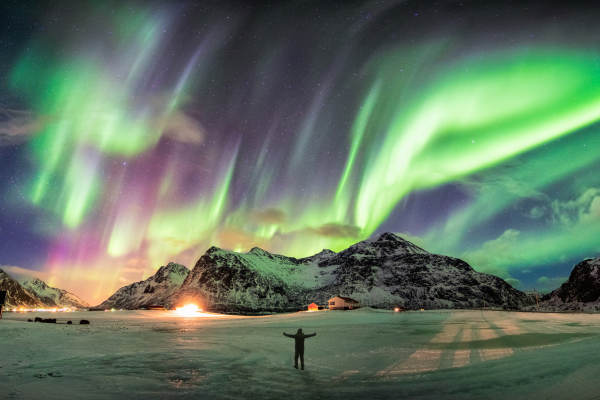
Astrotourism is the pursuit of the darkest skies and the most breathtaking celestial shows on Earth, and in Iceland this experience reaches its peak. The country’s northern latitude, combined with vast stretches of untouched wilderness and minimal light pollution, turns the island into one of the best places in the world to witness the Northern Lights, or Aurora Borealis. Few natural phenomena are as powerful or memorable: shimmering waves of green, purple, and pink sweep across the sky, sometimes appearing as soft arcs on the horizon, other times exploding into coronas that seem to rain light directly overhead.
To understand what makes the aurora appear at its most intense, three factors matter most. The first is solar activity, which fuels the brightness and movement of the lights. The second is sky darkness, something Iceland delivers in abundance thanks to its small population and strict protections against light pollution. The third is weather, since clouds can easily block the view. Fortunately, Iceland’s varied geography often means that if one area is cloudy, you can drive just an hour or two to find clear skies. The prime season to experience this spectacle runs from September through March, when nights are long and the sky remains dark for hours on end. Within that period, moon phases also play a role: the darker the night, the more vibrant the contrast of the aurora against the heavens.
What makes Iceland even more special is the way nature and culture merge into a single journey. Travelers can soak in geothermal hot springs at dusk, wander among glaciers and lava fields during the day, and then spend the night under skies alive with light. This combination of earthly beauty and cosmic wonder is what makes the island so irresistible to those who dream of traveling among the stars. In the sections that follow, we explore the very best places in Iceland to see the Northern Lights at their most intense, moving from the capital region to the remote corners where silence and darkness reign supreme.
Reykjavik and Surroundings
Most journeys in Iceland begin in Reykjavik, and while the capital is not the darkest location on the island, it serves as a perfect base for travelers who want to combine cultural experiences with the pursuit of the aurora. The city itself produces enough light to weaken faint displays, but just beyond its limits lie open stretches of coastline, plateaus, and nature reserves where the sky quickly turns dark. This makes Reykjavik ideal for the first nights of your aurora hunt, when you may not yet feel comfortable driving long distances on icy roads but still want a strong chance of success.
One of the most popular spots is the Grótta Lighthouse, perched on a small peninsula only a few minutes from the city center. On clear nights, the sea provides an expansive horizon, and when the aurora grows strong, the lighthouse becomes a striking silhouette against the glowing sky. To the southeast, the Heiðmörk Nature Reserve offers a quieter setting. Surrounded by woodlands, you can step away from artificial light and enjoy a calmer, more intimate view of the heavens. To the northeast, the Mosfellsheiði Plateau rises above the capital and often sits under clearer skies, offering panoramic views in every direction. Each of these areas is close enough to reach quickly, yet dark enough to provide the conditions needed for the aurora to shine with intensity.
What makes the region especially appealing is how adaptable it is. Local tour companies offer nightly excursions, using up-to-date weather forecasts and solar activity readings to drive visitors to the best viewing spots. Even if you explore independently, it is easy to check the aurora forecast, study cloud maps, and set out in whichever direction looks most promising. Because Iceland’s weather can change rapidly, being mobile is often the key to witnessing the phenomenon at its most brilliant.
When the aurora does appear near Reykjavik, it can be stunning. On strong nights, ribbons of light rise above the ocean, twist across the horizon, and sometimes culminate in radiant bursts directly overhead. The combination of accessibility, diverse landscapes, and the ability to adapt quickly makes the capital and its surroundings an excellent starting point for anyone determined to see the Northern Lights at their most intense.
Thingvellir National Park
Less than an hour from Reykjavik lies Thingvellir National Park, a place where history, geology, and astronomy meet in spectacular fashion. Recognized as a UNESCO World Heritage Site, Thingvellir is famous as the location of Iceland’s first parliament, but for astrotourists it offers something equally compelling: wide open skies, minimal light pollution, and landscapes that provide breathtaking backdrops for the Northern Lights.
Arriving at Thingvellir after dark, the first impression is the silence and immensity of the place. The rift valley, where the North American and Eurasian tectonic plates drift apart, creates a vast stage for the aurora. When the sky clears, the entire horizon becomes a canvas on which the lights perform, sometimes as faint arcs, other times as vibrant, pulsating curtains that ripple from side to side. On the strongest nights, the lights explode into coronas overhead, as if the heavens themselves were opening above the valley.
Thingvellir is also an extraordinary location for photography. The lava formations, the famous Almannagjá gorge, and the dark waters of Lake Thingvallavatn all add depth to aurora images. On calm nights, the lake can reflect the dancing lights, doubling the spectacle and creating the illusion that the stars are both above and below you. Travelers often position themselves near Öxarárfoss waterfall, where the combination of cascading water and glowing skies produces some of the most memorable aurora photographs in Iceland.
What makes the park even more appealing is its accessibility. Unlike some of the remote aurora destinations further north, Thingvellir can be reached quickly from Reykjavik, making it possible to plan a day of sightseeing and an evening of aurora hunting without long hours on the road. Visitors often spend the afternoon exploring the gorge, waterfalls, and tectonic plates, pause for dinner in nearby Laugarvatn or Selfoss, and then return to the park once the skies grow dark.
For those who want intensity, Thingvellir delivers. Its open horizons make it easy to see the aurora even when it rises low on the horizon, and its darkness enhances the colors, giving the lights a richer, more vivid appearance. When conditions align—solar activity high, skies clear, and the Moon absent—the valley transforms into one of the most powerful natural theaters on Earth. Watching the Northern Lights from this ancient landscape connects the visitor not only to the cosmos but also to centuries of Icelandic history, making the experience both cosmic and cultural at once.
Snæfellsnes Peninsula
Known as “Iceland in Miniature” because it condenses many of the country’s most striking landscapes into a single stretch of land, the Snæfellsnes Peninsula is one of the most atmospheric places to witness the Northern Lights. Located only a couple of hours northwest of Reykjavik, the peninsula offers a mix of glaciers, lava fields, rugged coastlines, and small fishing villages that seem to belong to another time. This diversity of scenery provides countless vantage points for aurora viewing, each more dramatic than the last.
At the heart of the peninsula stands Snæfellsjökull, a glacier-capped volcano shrouded in myth and legend. It was immortalized by Jules Verne in Journey to the Center of the Earth, and even today it carries an aura of mystery. When the aurora borealis ignites above the glacier, the entire landscape takes on a surreal quality, as if the earth and sky were merging in a single luminous performance. Photographers often favor this region for its iconic silhouettes and contrasts: black-sand beaches glowing under green skies, jagged cliffs bathed in purple aurora, or the snow-covered volcano reflecting pale lights from the heavens.
Unlike the busier Golden Circle or the capital area, Snæfellsnes tends to be quieter. The absence of large crowds gives travelers a sense of intimacy and solitude, enhancing the magic of the experience. Standing by the ocean with only the sound of waves and the rustle of the wind, watching ribbons of light stretch across the horizon, one feels the vastness of nature in its purest form.
Because of its location, the peninsula also offers relatively stable weather patterns compared to other parts of the island. While clouds are always a challenge in Iceland, the combination of coastal winds and open terrain often creates clear windows, giving travelers a better chance of catching the aurora at its peak. This makes Snæfellsnes a rewarding stop for those who want both scenic variety and higher odds of success.
For anyone seeking a mix of adventure, culture, and celestial wonder, the peninsula is unforgettable. From historic villages like Stykkishólmur to the dramatic lava formations of Arnarstapi, every corner of Snæfellsnes holds beauty by day and mystery by night. And when the Northern Lights appear, dancing above glaciers and ocean cliffs, the peninsula reveals why it is one of the most captivating places in Iceland for astrotourism.
Lake Mývatn – North Iceland
Traveling north into Iceland’s volcanic heartlands, visitors arrive at Lake Mývatn, a destination that combines geothermal wonders with some of the darkest and clearest skies in the country. Far from the bright lights of Reykjavik and the busier tourist circuits of the south, this region offers a perfect balance of accessibility and remoteness, making it one of the most rewarding places to observe the aurora borealis at full intensity.
The lake itself is a dramatic centerpiece. Formed by volcanic eruptions thousands of years ago, it is surrounded by lava pillars, craters, and steaming geothermal fields. At night, when the Northern Lights sweep across the sky, these strange landscapes become even more surreal. On still evenings, the aurora often reflects on the surface of the water, doubling the spectacle and giving observers the uncanny feeling of standing inside a cosmic mirror. Few places in Iceland create this sense of immersion, where the sky above and the earth below seem to dissolve into one glowing universe.
Another unique feature of the area is the Mývatn Nature Baths, sometimes called the “Blue Lagoon of the North.” These geothermal pools allow travelers to relax in steaming mineral-rich waters while the aurora dances overhead. Floating in the warmth while the sky ripples with color is an experience that combines comfort with awe, a reminder of how Iceland’s natural wonders complement one another in unforgettable ways.
The remoteness of Lake Mývatn also means that light pollution is virtually nonexistent. Small villages dot the region, but they are far apart and dimly lit, allowing the stars to shine with exceptional clarity. This makes Mývatn not only a top location for viewing the aurora but also a paradise for general stargazing and astrophotography. On clear nights, the Milky Way stretches vividly across the horizon, joining the aurora in one of the most spectacular celestial displays visible from Earth.
For travelers willing to venture beyond the south, Lake Mývatn rewards them with intensity, solitude, and unforgettable beauty. It is a place where the raw energy of Iceland’s volcanic landscapes meets the delicate light of the cosmos, offering an aurora experience that feels both otherworldly and deeply connected to the planet beneath your feet.
Akureyri and Surroundings
Further north, travelers encounter Akureyri, Iceland’s second-largest city, often referred to as the “Capital of the North.” While it is far smaller and quieter than Reykjavik, Akureyri provides a unique combination of urban comfort and quick access to some of the darkest skies in the country. This balance makes it an excellent base for those who want to enjoy the cultural and social amenities of a small city while keeping the Northern Lights within easy reach.
Unlike the bustling south, Akureyri’s urban glow is relatively modest. Within just a short drive beyond the city limits, the landscape opens into fjords, valleys, and snow-covered mountains where light pollution all but disappears. One of the most striking vantage points is along Eyjafjörður, the longest fjord in Iceland, where the still waters reflect the aurora in shimmering patterns. Watching green and purple lights ripple above while their mirror image dances on the surface below creates a breathtaking dual spectacle that photographers and travelers never forget.
The city itself has embraced its role as a gateway to the aurora. Local tour operators run nightly excursions into the surrounding countryside, using weather forecasts and solar data to maximize the chances of success. For independent travelers, Akureyri’s location is ideal: situated further north than Reykjavik, it often enjoys a greater frequency of visible auroras, especially during strong geomagnetic storms. This geographic advantage, combined with easy road access to nearby highlands and coastlines, makes it one of the most dependable places in Iceland for catching the lights.
Daytime in Akureyri is also rewarding. Visitors can explore botanical gardens, art galleries, and cozy cafés, all set against a backdrop of snowy peaks. This sense of cultural richness adds another layer to the journey, allowing travelers to experience both Icelandic life and cosmic wonder in the same trip. When evening falls, the transition from city warmth to icy wilderness feels seamless—just a twenty-minute drive can take you from a bustling café to complete silence under a blazing auroral sky.
Akureyri is proof that intensity does not always require isolation. Here, modern life and natural spectacle coexist harmoniously, offering travelers the comfort of a small city paired with some of the most powerful aurora displays in the northern hemisphere. For many, it represents the perfect balance between accessibility and awe, making it one of Iceland’s most memorable destinations for astrotourism.
East Iceland Coast
If there is one region of Iceland that feels truly untouched, it is the eastern coast. Far removed from the heavily visited south and west, East Iceland offers an experience of solitude that few other parts of the island can match. For aurora hunters, this seclusion comes with a reward: some of the darkest, clearest skies in the entire country.
The coastline here is dotted with tiny fishing villages and dramatic fjords carved by glaciers over millennia. At night, these fjords transform into natural amphitheaters for the Northern Lights. With almost no artificial illumination, the aurora glows fiercely above the jagged peaks and reflects in the still waters below, creating a scene that feels almost cinematic in its intensity. The remoteness of the area enhances the experience; when you stand on a deserted shoreline and see the sky ignite in waves of green and purple, there is nothing to distract from the raw power of the spectacle.
One of the greatest advantages of East Iceland is the absence of crowds. Unlike Reykjavik or the Golden Circle, where aurora tours can attract dozens of visitors, here you are often alone with the sky. This solitude deepens the sense of wonder and allows for a more personal connection with the natural world. It also means that photographers can take their time framing shots without interruption, capturing the lights as they bend and twist over mountains, fjords, and icy plains.
Reaching the eastern coast requires a longer journey, often along winding roads that pass through mountain passes and remote valleys. Yet for those willing to make the effort, the payoff is extraordinary. The silence, the remoteness, and the unbroken darkness create conditions where the aurora can truly be seen in its most vivid and powerful form. It is a destination for travelers who value authenticity and intensity above convenience, and for many, witnessing the Northern Lights here feels less like a tourist activity and more like a pilgrimage into the heart of Iceland’s wild beauty.
Jökulsárlón Glacier Lagoon
Among all of Iceland’s extraordinary landscapes, Jökulsárlón Glacier Lagoon may be the most surreal—and when the Northern Lights appear above it, the experience borders on the otherworldly. Located in the southeast of the country, along the famous Ring Road, the lagoon is filled with massive icebergs that have broken off from Breiðamerkurjökull, an outlet of the mighty Vatnajökull glacier. These blocks of blue and white ice float silently on the water, drifting slowly toward the Atlantic. At night, they become luminous sculptures, reflecting and refracting the aurora in ways that no other setting can match.
When the skies are clear and the aurora is strong, the lagoon transforms into a double universe: lights shimmer above in vibrant arcs while their reflections ripple across the icy waters below. Few places on Earth allow for such dramatic compositions, and for photographers, it is a true paradise. Long exposures capture not only the green and purple hues of the aurora but also the icy textures of the glaciers, creating images that look more like paintings than photographs. Even for those without a camera, the sight of glowing skies mirrored in frozen waters leaves an impression that feels eternal.
What adds to Jökulsárlón’s intensity is its setting. The lagoon lies between glaciers and the Atlantic coast, giving aurora watchers the rare opportunity to combine two elemental forces in one view: the frozen stillness of the ice and the restless rhythm of the sea. Just across the road, the so-called Diamond Beach extends the spectacle, where fragments of ice wash up on the black sand and glisten under the northern lights like jewels scattered by the tide. Standing there, surrounded by icebergs glowing green under the aurora, one begins to grasp the sheer poetry of Iceland’s landscapes.
Although Jökulsárlón is more accessible than East Iceland, it still retains an atmosphere of remoteness. The long drive from Reykjavik makes it a destination often included in multi-day trips rather than quick excursions, which means visitors often spend the night nearby and dedicate proper time to watching the skies. This slower pace heightens the sense of immersion. Rather than rushing back to the capital, travelers linger in silence, allowing the aurora to unfold above them in waves of color.
For many, Jökulsárlón is the pinnacle of aurora hunting in Iceland. It is not just about intensity or brightness, but about the setting itself—the way light, water, ice, and sky combine into one unrepeatable moment. To see the Northern Lights here is to witness nature’s artistry at its most profound, and it is no surprise that for countless visitors, the memory of Jökulsárlón stays with them long after they have left the island.
Conclusion
Experiencing the Northern Lights in Iceland is more than a bucket-list adventure; it is a profound encounter with the natural world at its most dramatic. From the convenience of Reykjavik and the historic landscapes of Thingvellir, to the mystical aura of Snæfellsnes, the volcanic beauty of Lake Mývatn, the cultural charm of Akureyri, the solitude of East Iceland, and the surreal reflections of Jökulsárlón, the island offers a spectrum of settings where the aurora borealis reveals itself with unmatched intensity. Each location carries its own character and atmosphere, allowing travelers to shape their journey according to their preferences—whether they value accessibility, remoteness, cultural richness, or raw wilderness.
To maximize the chances of seeing the aurora at its most vivid, timing is everything. The official season runs from September through March, when nights are longest and the skies remain truly dark for extended hours. Within that window, the weeks surrounding the new moon are particularly favorable, as moonlight can sometimes wash out the faintest curtains of aurora. Solar activity, measured by the Kp index, also plays a role: higher numbers usually mean brighter displays, though even a low index can produce breathtaking shows in Iceland thanks to its northern location. Travelers should remain flexible, checking cloud forecasts daily and being prepared to drive toward clearer skies if conditions shift.
Practical preparation is also essential. Icelandic weather is famously unpredictable, and temperatures during aurora season can drop quickly, especially at night in exposed areas. Dressing in multiple layers is the best strategy: thermal underwear, an insulating middle layer, and a waterproof outer shell to block wind and snow. Warm gloves, a hat, and sturdy boots are non-negotiable. Bringing a thermos with hot tea or coffee not only provides comfort but also makes the long waits more enjoyable. For those who plan to photograph the lights, a reliable tripod, spare batteries (which drain faster in the cold), and a wide-angle lens with a fast aperture will dramatically improve the results.
Technology can further improve the experience. Several mobile apps and websites provide real-time aurora forecasts, solar activity data, and cloud cover predictions. While no forecast is perfect, combining them with local knowledge—such as asking guides or hotel staff for advice—often makes the difference between success and disappointment. Many local tour operators also specialize in aurora hunting, offering small-group excursions where experienced guides chase the clearest skies. For first-time visitors who may feel nervous about driving on icy roads at night, these tours can be both safer and more efficient.
Yet beyond the science and planning lies the deeper essence of aurora watching: patience and presence. The Northern Lights are unpredictable, and sometimes the wait is long. There are nights when the lights flicker faintly and then fade, and others when they suddenly burst into a sky-wide explosion of color, leaving everyone speechless. That unpredictability is part of their power. Standing outside under the Icelandic sky, breathing in the cold air, and watching the horizon for signs of green teaches travelers to slow down, to look more carefully, and to savor the rare moments when the universe reveals its hidden beauty.
Ultimately, Iceland is not just a place to see the Northern Lights; it is a stage where earth and sky collaborate to create one of nature’s greatest performances. Glaciers, volcanoes, lagoons, fjords, and mountains provide the set, while the aurora borealis paints the night with light. Whether you find yourself surrounded by silence in East Iceland, floating in hot springs at Lake Mývatn, or watching reflections ripple across Jökulsárlón, the experience leaves a lasting imprint on both memory and imagination.
If you dream of a journey to the stars, let Iceland be your destination. Come prepared, stay patient, and allow the northern skies to surprise you. The aurora will not only illuminate the heavens but also leave a glow within you—one that lingers long after the lights themselves have faded.