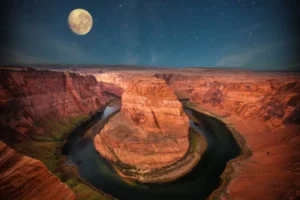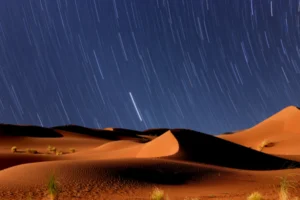
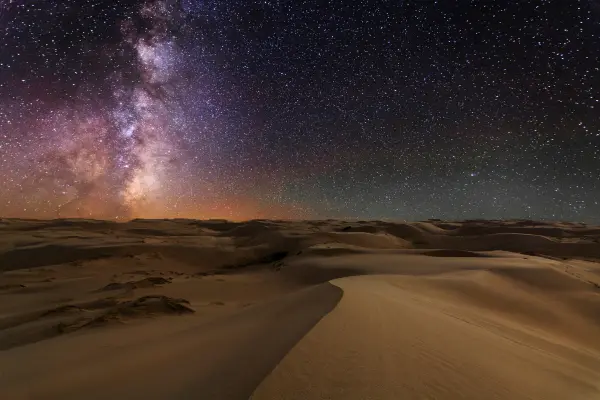
Astrotourism has become one of the fastest-growing trends in global travel, attracting people who are eager to look beyond cities and monuments to discover the wonders of the night sky. For many, the appeal lies in combining breathtaking landscapes with pristine darkness, creating moments where Earth and cosmos meet in harmony. Deserts, with their dry climates and remote locations, are among the best environments for such experiences—and no desert embodies this more perfectly than the Atacama in northern Chile.
Known as the driest non-polar desert on Earth, the Atacama stretches for nearly 1,000 kilometers along the Pacific coast. Its geography provides unparalleled conditions for astronomy: high altitudes that rise above much of the atmosphere, extremely low humidity, and more than 300 clear nights each year. These unique factors make the sky above the Atacama so sharp and transparent that even the faintest details of the Milky Way or distant galaxies can be observed with astonishing clarity.
This is why the Atacama has become both a scientific hub and a dream destination for travelers. Astronomers from around the world establish research facilities here, while stargazers and photographers flock to towns like San Pedro de Atacama to join guided tours, night photography sessions, or simply to lie on the sand and watch the stars unfold.
But the Atacama is more than just science—it is also about culture, heritage, and wonder. For centuries, indigenous peoples of the region looked to the stars for guidance, weaving myths and traditions that are still shared today. The desert, with its silence and vastness, allows modern visitors to feel that same timeless connection.
In this article, we will explore why the Atacama Desert is considered a true paradise for astronomers and stargazers alike, blending natural conditions, world-class research, cultural richness, and unforgettable cosmic beauty.
The Unique Skies of the Atacama
The Atacama Desert is often described as the clearest window into the universe, and this reputation is no exaggeration. The region’s geography and climate create ideal conditions for stargazing and astronomical research. Rising to elevations of more than 2,500 meters (8,200 feet), the desert sits above much of the atmospheric distortion that hinders sky visibility at lower altitudes. Combined with its near-total absence of rainfall—the Atacama is the driest non-polar desert on Earth—the result is air so crisp and transparent that the stars shine with unrivaled intensity.
Another advantage is the extraordinary number of clear nights per year—over 300 on average. This means that astronomers and visitors alike can count on consistent visibility, a rarity in many other parts of the world. The low humidity also reduces atmospheric scattering, allowing for sharper, brighter views of celestial objects. Even the naked eye can easily spot the Milky Way arching across the desert sky, with its dense clusters of stars and nebulae visible in astonishing detail.
The Atacama’s remoteness plays a crucial role as well. Far from the light pollution of large cities, the desert provides some of the darkest skies on Earth. Here, constellations of both the Northern and Southern Hemispheres can often be seen, thanks to the desert’s latitude and geography. For astrophotographers, this makes the Atacama a dream destination, where long exposures capture both terrestrial beauty—salt flats, volcanic peaks, and red canyons—and the cosmic wonders above.
Simply put, the Atacama offers conditions so exceptional that astronomers describe it as one of the closest things we have to an “open-air space observatory.”
World-Class Observatories
The Atacama’s unique skies have not only attracted travelers but also some of the most ambitious astronomical projects in human history. The desert is home to several world-class observatories that make it a global hub for scientific discovery.
Among the most famous is ALMA (Atacama Large Millimeter/submillimeter Array), located at an altitude of 5,000 meters on the Chajnantor Plateau. ALMA is the largest radio telescope project in the world, with 66 high-precision antennas working together to study the universe in unprecedented detail. From star formation to distant galaxies, ALMA has revolutionized our understanding of cosmic evolution.
Equally impressive is the Paranal Observatory, operated by the European Southern Observatory (ESO). Its flagship instrument, the Very Large Telescope (VLT), consists of four massive 8.2-meter telescopes that can be used independently or combined to achieve extraordinary resolution. Images captured from Paranal have set global records in astronomy, from detailed observations of exoplanets to some of the deepest views into the universe.
Other facilities, such as the La Silla Observatory, further enhance the Atacama’s scientific significance. Together, these observatories attract international teams of researchers, turning the desert into a crossroads of global astronomy.
For visitors, some observatories offer guided tours and public nights, allowing travelers to witness not only the grandeur of the skies but also the cutting-edge technology used to study them. This rare opportunity to combine science tourism with astrotourism makes the Atacama unique. It is not just a place to observe stars—it is where the future of astronomy is actively being shaped.
Astrotourism for Travelers
While scientists come to the Atacama Desert to make groundbreaking discoveries, travelers are equally drawn to its skies for personal and emotional experiences. The town of San Pedro de Atacama serves as the main hub for astrotourism in the region, offering a wide range of stargazing tours and experiences tailored to all levels of interest.
Guided astronomy tours often take place just outside the town, where small groups gather under crystal-clear skies. Professional guides, many equipped with powerful telescopes, help visitors identify constellations, planets, and nebulae. For many travelers, this is their first time seeing Saturn’s rings or the moons of Jupiter through a telescope—an unforgettable moment that transforms curiosity into awe.
Astro-lodges and boutique hotels in the Atacama go a step further by integrating astronomy directly into their services. Many feature rooftop observation decks, private telescopes, and even night photography workshops led by experts. Guests can enjoy a dinner under the stars, followed by a session capturing long-exposure images of the Milky Way rising above the desert’s surreal landscapes.
Astrophotography has become one of the most popular activities, with the Atacama’s salt flats, volcanic peaks, and unique rock formations providing perfect foregrounds for cosmic images. Workshops cater to both beginners and advanced photographers, ensuring that everyone leaves with memories captured on camera.
For those seeking a more intimate experience, simply lying on the desert floor, wrapped in a blanket, and watching the stars in silence is often the highlight of a trip. In the Atacama, travelers don’t just observe the night sky—they immerse themselves in it, making the desert feel like a natural cathedral of the cosmos.
Culture, Science, and Wonder Combined
What sets the Atacama apart from other dark-sky destinations is its ability to blend science, culture, and spirituality into one experience. For thousands of years, indigenous communities such as the Atacameños (Likan Antai) have looked to the sky for guidance, weaving myths, calendars, and rituals around the stars. Constellations were not just patterns of light but symbols tied to agriculture, navigation, and the cycle of life. Even today, local guides share these ancestral stories, allowing visitors to see the sky not only as a scientific map but also as a cultural tapestry.
This cultural dimension enriches astrotourism in the Atacama. Tours often begin with modern astronomy, using telescopes and laser pointers to explain celestial phenomena, and then transition into storytelling that connects the stars to human history. This fusion creates a holistic experience where travelers understand that astronomy is not just about science—it is also about our shared human relationship with the cosmos.
At the same time, the Atacama continues to be a center of cutting-edge research. The presence of world-class observatories like ALMA and Paranal coexists with local traditions, bridging ancient wisdom and modern discovery. Visitors are reminded that astronomy is both timeless and ever-evolving, linking past, present, and future.
The sense of wonder in the Atacama is amplified by its landscapes. Standing among red canyons or salt flats under a sky ablaze with stars, travelers often describe the experience as spiritual. It is a place where silence, immensity, and the brilliance of the cosmos combine to create moments of profound reflection.
In the Atacama, astrotourism is more than an activity—it is an immersion into a dialogue between Earth and sky, science and culture, wonder and understanding.
Practical Tips for Astrotourists
Traveling to the Atacama Desert for stargazing is an unforgettable adventure, but preparation is key to making the most of the experience. The first factor to consider is timing. The Atacama boasts more than 300 clear nights per year, but conditions are best between March and October, when the core of the Milky Way is most visible in the Southern Hemisphere. To maximize visibility, plan your visit during a new moon or when the moon is below the horizon, as its brightness can wash out the fainter stars.
Altitude is another important consideration. Many stargazing spots, and especially observatories like ALMA, are located at over 2,500 meters (8,200 feet) above sea level. Some visitors may experience mild altitude sickness, so it’s important to acclimate slowly, stay hydrated, and avoid strenuous activity in the first few days.
Packing correctly will also enhance your experience. Even though the desert is hot during the day, nighttime temperatures can drop sharply, especially in winter, sometimes close to freezing. Warm clothing, layered outfits, gloves, and hats are essential for comfort during long observation sessions. For astrophotographers, a sturdy tripod, wide-angle lens, and extra batteries are must-haves, as cold nights drain power quickly.
Booking with a reputable local tour company ensures safety and expertise. Guides not only provide equipment and knowledge but also lead you to the best dark-sky spots away from towns. Many also offer cultural storytelling, adding depth to the experience.
In short, preparation allows travelers to enjoy the Atacama fully, but the desert itself guarantees the magic. With its clarity, immensity, and silence, every night in the Atacama becomes a memory etched into both mind and camera.
Conclusion
The Atacama Desert is more than a destination—it is a stage where the universe performs at its most brilliant. With its dry climate, high altitudes, and almost constant clear skies, it offers conditions that few places on Earth can match. This is why astronomers consider it a global hub for research, and why travelers describe it as a paradise for stargazing.
But the Atacama’s greatness lies not only in its science. It is a place where the cosmos meets culture, where the ancient traditions of indigenous peoples blend with cutting-edge observatories, and where travelers from around the world come to share in a universal sense of wonder. Whether through guided tours, astrophotography workshops, or simply lying on the desert floor in silence, visitors experience more than just stars—they connect with a vast, timeless universe.
The desert also provides perspective. Standing beneath the Milky Way as it arches above volcanic peaks and salt flats, one cannot help but feel both humbled and inspired. It is a reminder of how small we are, yet how deeply we belong to the cosmos.
For astronomers, photographers, and dreamers alike, the Atacama is not just a location—it is a paradise of discovery, reflection, and beauty. Its skies invite us to look beyond ourselves, to seek knowledge, and to feel awe in equal measure.✨ Astrotourism in the Atacama is not just about seeing the stars—it is about experiencing them in one of Earth’s most extraordinary landscapes.