
Since the dawn of civilization, human beings have looked up at the night sky in awe, trying to make sense of the twinkling lights scattered across the darkness. For early societies, the stars were not just distant suns or astronomical bodies; they were symbols, messages, and sometimes even divine beings. Cultures across the world created stories to explain the origins of the stars, their movements, and the patterns they formed. These stories—what we now call star mythologies—shaped how people understood the universe and their place within it.
Beyond pure imagination, the stars also served as practical tools. They guided ancient travelers across deserts and oceans, provided farmers with seasonal calendars, and gave priests and rulers signs to legitimize power. But their most enduring role was in storytelling. From mighty hunters and tragic lovers to cosmic battles and ancestral spirits, constellations became a celestial book in which every culture inscribed its beliefs and values.
In this article, we will explore how different cultures interpreted the sky, weaving myths and legends into a shared human quest for meaning. From Greek heroes to Aboriginal Dreamtime, these stories reveal that while we live in different lands, we all share the same sky.
The Role of the Stars in Human Culture
The stars have always been more than simple points of light. They became essential companions for survival and meaning. Practically speaking, they provided the earliest form of navigation. Ancient sailors used constellations like the North Star to chart their way across vast oceans, while desert caravans relied on star maps to cross endless dunes. Farmers also looked to the heavens for cues: the appearance of certain constellations often marked the right time to sow or harvest crops.
Beyond practical uses, stars carried deep emotional and spiritual weight. For many, they were divine messengers or ancestors watching over the living. The night sky offered a sense of connection to something larger, a cosmic order that gave structure to human life. Looking upward evoked both fear and wonder: fear of the unknown darkness, but wonder at the beauty and mystery of creation.
Stars also became powerful vehicles for storytelling. By connecting dots in the sky, humans transformed random patterns into meaningful figures—animals, gods, and heroes. These stories preserved cultural wisdom, moral lessons, and collective memory, ensuring that every generation could gaze upward and recall the same myths.
Greek and Roman Constellations
One of the most influential star mythologies comes from the ancient Greeks, whose stories continue to shape how we interpret the sky today. For the Greeks, constellations were not abstract shapes but living myths preserved in the heavens. The mighty hunter Orion, for example, was immortalized among the stars after his death, forever chasing the Pleiades across the night sky. Andromeda, chained to a rock as sacrifice, is remembered through the stars near Perseus, her rescuer. These myths brought drama, romance, and tragedy into the night sky, turning it into a celestial stage.
The Romans inherited much of Greek mythology, adapting the stories into their own culture. Through Latin astronomy, these constellations spread across Europe and became the basis for the star charts we still use today. When Renaissance scholars revived classical knowledge, they turned again to Greek and Roman constellations, ensuring their survival in modern science.
What makes these myths enduring is not only their beauty but also their universality. They reflect timeless human themes: love, heroism, jealousy, and fate. When we look at Orion or Cassiopeia today, we are not just identifying constellations—we are sharing in stories told for thousands of years under the same sky.
Egyptian Star Mythology
In ancient Egypt, the stars were more than lights in the sky—they were divine forces guiding life and death. The most important was Sirius, known to the Egyptians as Sopdet. Each year, its heliacal rising coincided with the flooding of the Nile, the event that nourished the land and allowed crops to thrive. This connection made Sirius a symbol of renewal, abundance, and cosmic order.
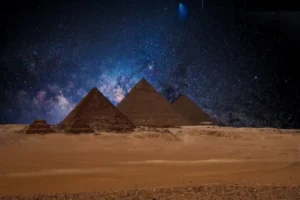
The constellation Orion also held sacred meaning. Egyptians associated it with Osiris, the god of the afterlife and rebirth. The alignment of the pyramids at Giza with Orion’s belt suggests how deeply astronomy and mythology were intertwined. By linking monumental architecture to the heavens, the Egyptians believed they were securing eternal life for their pharaohs and ensuring harmony with the gods.
For the Egyptians, the night sky was a reflection of the afterlife. Stars were sometimes seen as the souls of the dead sailing across the heavens, watched over by Nut, the sky goddess. Mythology, science, and religion blended seamlessly, with celestial patterns serving as both a calendar and a sacred map. Egyptian star myths remind us how deeply the cosmos was woven into daily survival, spiritual beliefs, and monumental achievements.
Indigenous American Sky Legends
Indigenous peoples across the Americas developed rich star mythologies that reflected their environment, traditions, and spiritual worldview. For the Navajo, the constellations were carefully placed by Coyote, the trickster spirit, who scattered stars into the sky in both wisdom and mischief. These stories emphasized balance in nature and moral lessons about harmony.
In South America, the Inca took a unique approach to the heavens. Instead of focusing only on bright constellations, they identified “dark constellations,” figures formed by the dark clouds within the Milky Way. These shapes included animals like the llama and the serpent, each tied to agricultural cycles and survival. The Milky Way itself was viewed as a celestial river, mirroring the sacred rivers of the earth.
Stars were also closely tied to community life. Many Indigenous myths connected celestial beings with ancestors, guiding ceremonies, planting seasons, and storytelling traditions. By looking at the night sky, people could recall their cultural values and strengthen their bonds to the land.
These sky legends remind us that mythology is not just about entertainment—it is a living system of knowledge, teaching respect for nature and unity with the cosmos.
Chinese and Japanese Interpretations
In East Asia, star mythology developed into a complex system blending science, philosophy, and storytelling. Ancient Chinese astronomers divided the sky into the “Three Enclosures” and the “Twenty-Eight Mansions,” a system used for both astrology and imperial power. Constellations were seen as mirrors of the earthly world, with stars representing emperors, officials, and cosmic harmony. The belief was that the order of the heavens reflected the order of society, making astronomy deeply political as well as spiritual.
In Japanese tradition, one of the most beloved celestial myths is the story of Orihime and Hikoboshi, two lovers separated by the Milky Way. Allowed to meet only once a year, their reunion is celebrated during the Tanabata Festival, when people write wishes on colorful paper and hang them from bamboo trees. This story highlights themes of love, longing, and the cosmic forces that shape human destiny.
Both Chinese and Japanese interpretations show how the stars served as bridges between the human and divine. They were guides for rulers, calendars for farmers, and storytellers for communities. Even today, these myths live on through festivals, art, and cultural traditions, keeping alive the timeless wonder of the starry sky.
Hindu and Buddhist Celestial Stories
In Hindu tradition, the stars are woven into a vast cosmic framework that blends mythology, astrology, and spirituality. The night sky is divided into 27 nakshatras—lunar mansions that mark the moon’s passage each night. Each nakshatra is linked to a deity, carrying specific influences on human destiny. This system remains central in Vedic astrology, where the position of stars and planets at birth is believed to shape a person’s life path.
Many Hindu myths personify stars as gods or heroes. The Pleiades, known as the Krittikas, are seen as six mothers who nurtured Kartikeya, the god of war. Orion is connected to Prajapati, a creator figure, whose pursuit of his daughter is told as a cosmic story of desire, morality, and divine intervention.
Buddhism also adopted celestial symbolism, though often with a philosophical twist. Stars were seen less as divine beings and more as reminders of impermanence and interconnectedness. Some Buddhist texts describe stars as guiding lights in meditation, helping practitioners focus on the vastness of existence. In East Asia, star deities became protectors within Buddhist cosmology, blending with local traditions.
Together, Hindu and Buddhist star myths illustrate how the cosmos was not distant but deeply integrated into spiritual practice and daily life.
African and Aboriginal Perspectives
Across Africa, the stars are living symbols of ancestry, guidance, and sacred wisdom. The Dogon people of Mali developed remarkably detailed knowledge about Sirius, which they called Sigui Tolo. Their mythology describes it as a twin star system, an insight that modern astronomy confirmed centuries later. For the Dogon, Sirius was tied to creation myths and sacred ceremonies that connected humans to cosmic origins.
Among the Zulu of South Africa, stars were often seen as the eyes of ancestors watching over the living. The first star of the evening, called iKhwezi, carried spiritual importance as a guide for both rituals and daily activities. These beliefs highlight the close link between the heavens, family lineage, and spiritual protection.
In Australia, Aboriginal peoples created some of the world’s oldest star stories, preserved for tens of thousands of years through oral tradition. Their “Dreamtime” stories map the night sky directly onto the land, ensuring that celestial patterns guided navigation, hunting, and cultural teachings. The “Emu in the Sky,” formed from the dark spaces of the Milky Way, is one of their most famous constellations, tied to seasonal knowledge and spiritual meaning.
These traditions remind us that for many cultures, the sky is not separate from the earth but a mirror of it.
Shared Themes Across Cultures
While the details of star myths vary from one culture to another, striking similarities appear across the world. Stars are often seen as divine messengers, ancestors, or beings who influence human fate. Whether it is the Greek gods immortalized in constellations or the Zulu belief in stars as ancestral spirits, the heavens are consistently viewed as a realm where the human and the divine intersect.
Another recurring theme is the cycle of life, death, and rebirth. In Egypt, Orion symbolized Osiris and eternal resurrection, while in Hindu tradition, constellations reflected cosmic order and karmic cycles. The stars offered assurance that even in death, life continued in another form, shining eternally above.
Stories also reflect universal human emotions: love and longing in the Japanese Tanabata myth, bravery and heroism in Greek tales of Perseus, and respect for nature in Inca and Aboriginal traditions. These narratives transformed the night sky into a shared cultural canvas, one that expressed values, fears, and hopes.
Ultimately, star mythologies show that despite vast differences in geography and history, humanity shares a common impulse: to look upward and search for meaning. The stars unify us, offering both mystery and connection across time and culture.
Conclusion
From the deserts of Egypt to the mountains of Peru, from the plains of Australia to the temples of India, humanity has always turned its eyes to the stars for meaning. Each culture interpreted the night sky in its own way, weaving stories that reflected its environment, beliefs, and values. The Greeks saw gods and heroes immortalized in constellations; the Egyptians saw the promise of rebirth; Indigenous peoples saw animals, ancestors, and guides tied to the rhythms of the earth.
What unites these diverse traditions is the human need to connect with something greater than ourselves. The stars offered both practical guidance—helping farmers plant, sailors navigate, and rulers govern—and spiritual reassurance, reminding us of cycles of life, love, and eternity. They became the world’s first universal language, understood not with words but with wonder.
Today, modern science explains stars as distant suns, galaxies, and cosmic phenomena. Yet these ancient myths remain powerful, not because they describe the universe with precision, but because they reveal how we, as humans, sought to understand it. Looking up at the same sky, we inherit a shared legacy of stories that continue to inspire imagination and remind us of our place in the cosmos.